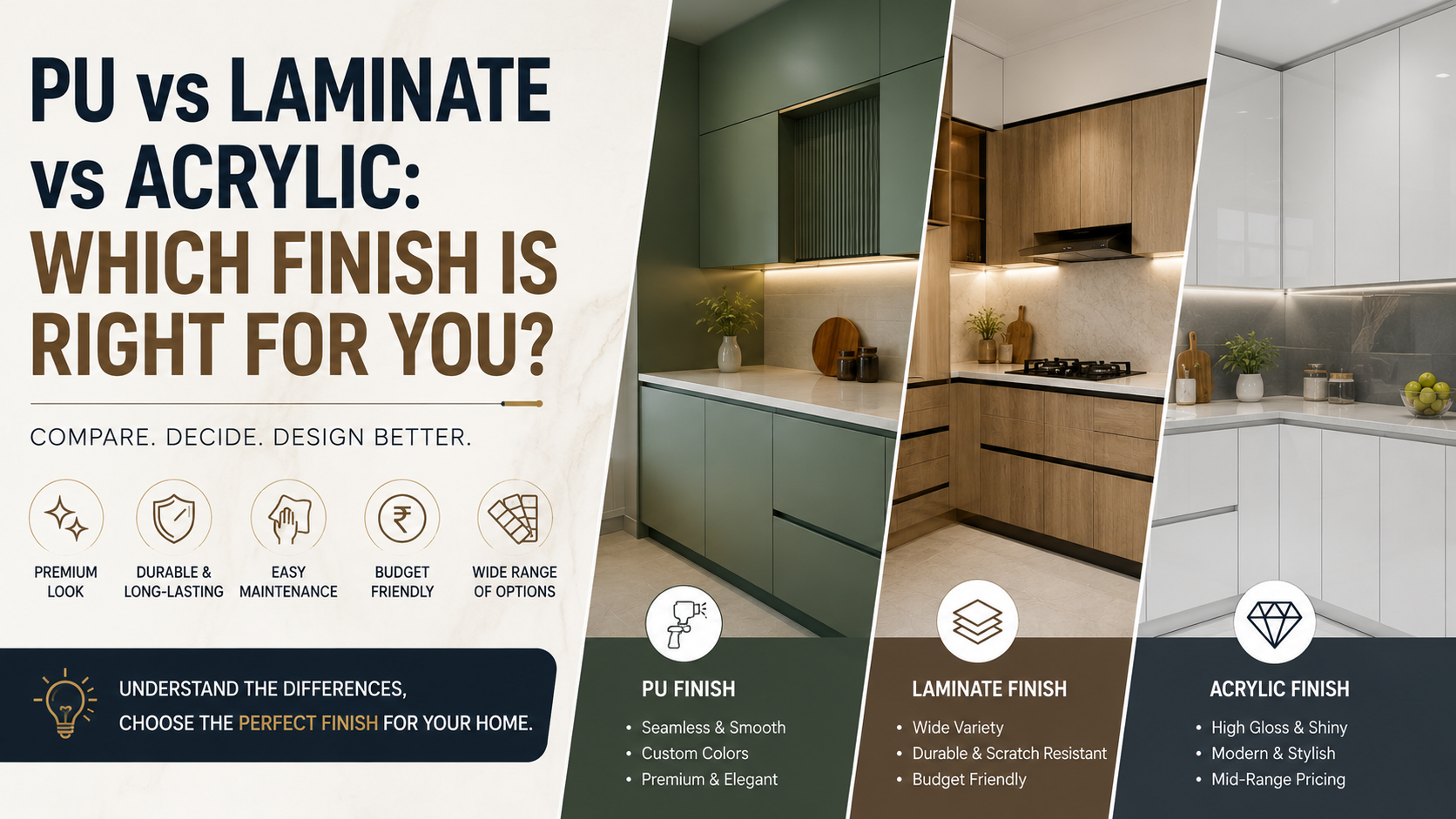
Choosing between PU, laminate, and acrylic? Compare their durability, cost, maintenance, and finish to find the best option for your kitchen or wardrobe.
When you are designing a modular kitchen or wardrobe, the finish you choose matters more than most people realize. It affects how your home looks on day one, how easy it is to maintain five years later, and how much you end up spending. The three finishes that come up in almost every design conversation are PU, laminate, and acrylic. Each one has a distinct character, a specific use case, and a price point that reflects what you are getting.
Here is an honest breakdown of all three so you can make a decision that actually fits your home and your lifestyle.
What is PU Finish?
PU stands for polyurethane. It is a liquid coating applied in multiple layers directly onto an MDF or HDHMR board surface, with sanding done between each coat. The result is a perfectly smooth, painted finish that looks hand-crafted and seamless.
Because it is spray-applied, PU gives you complete color freedom. Any shade from a RAL or Pantone chart can be matched, which makes it the go-to choice for homeowners who want a specific color that no laminate sheet or acrylic panel offers. The finish is available in matte, satin, and high gloss options.
PU is the most premium finish of the three, both in terms of look and cost.
What is Laminate Finish?
Laminate is a decorative sheet made by pressing together layers of flat paper and plastic resins under high pressure. The top layer carries a printed pattern or color, giving you a wide range of options from plain matte tones to wood grain textures, stone effects, and ultra-high gloss.
It is bonded onto a plywood or MDF substrate and edge-banded at the corners. Laminate is the most widely used finish in Indian homes because it balances cost, durability, and variety better than anything else available at its price point.
You get it in matte, gloss, soft-touch, and textured variants from brands like Greenlam, Century, Merino, and others.
What is Acrylic Finish?
Acrylic is a 1mm thick sheet of thermoplastic material bonded onto an MDF or HDHMR board. It delivers a deep, high-gloss finish that reflects light with a clarity that laminate gloss cannot fully replicate.
It is non-toxic, water-resistant, and available in a range of solid colors and some sparkle finishes. Acrylic gives kitchens a sleek, contemporary look and is popular in urban apartments where the kitchen is visible from the living area and needs to make a visual impression.
It sits between laminate and PU in terms of price.
PU vs Laminate vs Acrylic: Key Differences
Finish appearance
- PU: Smoothest, most seamless, painterly quality
- Acrylic: High gloss, deep reflective shine
- Laminate: Wide range from matte to gloss, slightly visible panel seams up close
Durability
- Laminate: Most scratch and stain resistant day-to-day
- Acrylic: Durable but shows fine scratches over time, especially in darker colors
- PU: Can be touched up easily but needs careful handling to avoid deep scratches
Maintenance
- Laminate: Wipe clean, no polishing required, easiest to maintain
- Acrylic: Regular wiping needed to keep the gloss looking clean, fingerprints show on dark shades
- PU: Easy to clean but needs gentle handling; avoid abrasive cleaners
Cost
- Laminate: Most budget-friendly option
- Acrylic: Mid-range in pricing
- PU: Premium pricing, highest of the three
Color options
- Laminate: Widest range, hundreds of colors and textures
- Acrylic: Good range of solid colors and some sparkle options
- PU: Unlimited, any RAL or Pantone shade possible
Pros and Cons of PU Finish
Pros
- Completely seamless finish with no visible panel joints
- Unlimited color customization
- Available in matte, satin, and gloss
- Can be sanded and re-coated if damaged
- Looks genuinely premium, especially in matte
Cons
- Most expensive of the three
- Quality depends entirely on the painter and application process
- Longer curing time during installation
- Not ideal for very high-moisture environments without proper sealing
- Dust can settle on wet coats during application if not done in a controlled space
Pros and Cons of Laminate Finish
Pros
- Most affordable and widely available
- Extremely durable and scratch resistant
- Lowest maintenance of the three
- Huge range of colors, textures, and effects
- Works well in kitchens, wardrobes, and all carpentry
Cons
- Panel seams are visible up close on large surfaces
- Cannot achieve the fully seamless look of PU or the depth of acrylic gloss
- Lower-quality laminates can peel at edges over time if edge-banding is poor
- Gloss laminate can look flat compared to acrylic
Pros and Cons of Acrylic Finish
Pros
- Deep, reflective high-gloss that brightens spaces
- Non-toxic and water-resistant
- Good durability when handled with care
- Works well in compact kitchens where light reflection is needed
- More affordable than PU while still feeling premium
Cons
- Shows fingerprints and fine scratches more than laminate
- Scratches are hard to repair without replacing the panel
- Not available in textures or wood-effect finishes
- Dark acrylic colors need frequent cleaning to look presentable
Which Finish is Best for Your Home?
There is no single right answer. The best finish depends on your priorities. If you are still working out your overall interior design budget, understanding finish costs upfront will help you plan each room more accurately.
Choose laminate if:
- You want the most practical, low-maintenance finish
- Your budget is in the mid-range
- You want variety in texture and color including wood grain effects
- You have an active kitchen with daily heavy use
Choose acrylic if:
- You want a high-gloss, modern look without going to PU pricing
- Your kitchen is visible from a living or dining area and needs to look sharp
- You are willing to maintain it regularly to keep the shine
Choose PU if:
- You want a completely seamless, painted finish
- You have a specific color in mind that no sheet finish can match
- You are doing a luxury or premium kitchen where finish quality is the priority
- Budget is not the primary constraint
A hybrid approach often works best. Many designers in Bengaluru use acrylic or PU on the visible base and wall shutters, and switch to laminate on tall units, hidden panels, and internal surfaces. This gives you the premium look where it counts and keeps overall costs in check. If you are planning a 3BHK interior, this hybrid method is one of the smartest ways to manage spend without compromising on the areas that matter visually.
Conclusion
PU, laminate, and acrylic each serve a different kind of homeowner. Laminate is the sensible workhorse. Acrylic is the glossy showpiece. PU is the premium custom finish. Knowing what each one actually delivers helps you spend in the right place rather than overspending everywhere or cutting corners where it shows.
For a complete picture of how finish choices fit into your overall home budget, read our guide on interior design costs in Bangalore. And if you are still working through your kitchen layout and design brief, our modular kitchen design guide is a good place to start before locking your finish.
If you need help deciding which finish suits your specific kitchen layout, budget, and lifestyle, the DecoGully design team is happy to walk you through the options. Reach out today and book a free consultation.
FAQs
Which is more durable: PU, laminate, or acrylic?
Laminate is the most durable for everyday kitchen use. It resists scratches, stains, and cleaning chemicals better than the other two. Acrylic and PU are more delicate and need careful handling to maintain their appearance over time.
Can I use a combination of these finishes in one kitchen?
Yes, and it is actually a smart approach. Using acrylic or PU on visible shutters and laminate on hidden or high-wear surfaces gives you a premium look without the full premium cost. Many designers recommend this hybrid method.
Which finish is easiest to maintain?
Laminate is the easiest by far. A quick wipe is enough. Acrylic needs regular cleaning to avoid fingerprint buildup, and PU requires gentle handling to avoid surface damage.
Is PU finish worth the extra cost?
If you want a specific color, a seamless painted look, or a truly luxury finish, yes. For a practical family kitchen, laminate delivers better value. PU makes the most sense for feature kitchens, islands, or spaces where the visual impact justifies the spend.
Which finish is best for small kitchens?
Acrylic or high-gloss laminate works well in small kitchens because the reflective surface bounces light and makes the space feel larger. Matte finishes, while beautiful, absorb light and can make compact kitchens feel smaller.


CommentsBe the first